
Table of Contents
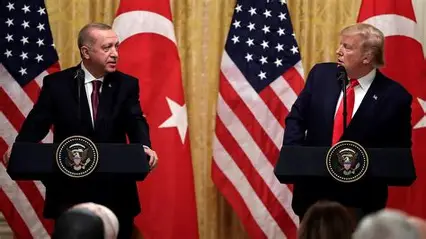
In a wide-ranging press conference that spanned global security, NATO spending, Middle East diplomacy, and U.S., Turkey relations, the president addressed urgent questions from journalists about sanctions, defense cooperation, hostage negotiations, and the fragile balance of international alliances. The session, held against the backdrop of ongoing conflicts in Ukraine and Gaza, underscored the administration’s attempt to balance deterrence with diplomacy, and strength with negotiation.
Sanctions on Turkey: A Tense Diplomatic Balancing Act
One of the most pointed questions centered on whether the U.S. was preparing to impose sanctions on Turkey. The president made clear that the possibility remained very real, stating that sanctions “could be very soon” depending on the outcome of meetings with Turkish officials. His comments reflected the delicate U.S., Turkey relationship, which has been tested by disputes over defense purchases, human rights concerns, and Ankara’s sometimes divergent stance within NThat decision led to Turkey being expelled from the F-35 fighter jet program, creating years of friction between Washington and Ankara. While relations have since warmed in certain areas, tensions remain, and any new sanctions could impact Turkey’s economy and its strategic defense cooperation with the West.
On the subject of tariffs, the president indicated discussions were underway but offered no firm commitments. His remarks hinted at the broader economic stakes: as Turkey’s economy struggles with high inflation and currency volatility, new U.S. sanctions or unresolved tariff disputes could intensify pressure on Ankara’s leadership.
NATO Spending: From 2% to 5% of GDP
The president was eager to highlight NATO’s recent progress on defense spending, claiming that member nations had shifted from the alliance’s long-standing target of 2% of GDP toward an unprecedented 5%. If accurate, this represents a historic change, as NATO members have often fallen short of the 2% guideline first agreed to in 2014.
According to the president, this dramatic increase represents “trillions of dollars” invested in the alliance’s collective security. He stressed that the U.S. is no longer “giving away” military resources but instead selling high-tech weapons systems like Javelins, Patriots, and other missile systems to its allies. This shift, he argued, ensures NATO members are not only contributing more financially but also directly strengthening their military capabilities.
This emphasis on NATO allies “paying their share” has been a recurring theme in U.S. politics, with several administrations urging Europe to invest more heavily in defense. The current administration appears determined to present itself as having achieved what past leaders could not: significant financial commitments from NATO’s European members at a moment when both Russia’s invasion of Ukraine and escalating Middle East conflicts make alliance unity more critical than ever.
Ukraine War and NATO’s Air Defense Concerns
Questions about NATO inevitably turned to the war in Ukraine, where Russian missile and drone strikes continue to test the limits of Ukrainian air defenses. The president acknowledged the vulnerabilities in NATO airspace but pointed to the new wave of defense spending as evidence that the alliance was rapidly strengthening its capabilities.
Since the Russian invasion in February 2022, NATO has poured billions into supporting Ukraine, with the U.S. providing advanced systems like HIMARS rocket launchers and Patriot missile batteries. Still, concerns linger that Russia’s long-range strikes could spill over into NATO territory, particularly in Poland or the Baltic states. The president’s remarks suggested confidence in the alliance’s ability to deter escalation, but also hinted at the fragility of European security.
On the issue of Russian oil, the president admitted disappointment that some NATO members had not fully halted purchases. Despite coordinated sanctions and price caps, Moscow continues to generate revenue from energy exports, a lifeline for funding its war. Yet, the president praised NATO nations for their broader cooperation, noting that energy dependence is being reduced steadily even if not yet eliminated.
Gaza Crisis: Hostages, Ceasefire Talks, and Regional Diplomacy
The Gaza conflict took center stage during the press conference, with reporters pressing the president on U.S. efforts to negotiate both a ceasefire and the release of hostages. He revealed that intelligence suggested about 20 hostages were still alive, while at least 38 had been killed. Families of the deceased, he emphasized, were desperately urging governments to help return the bodies of their loved ones for burial.
The president underscored that hostage negotiations had already yielded results, with several captives released in recent weeks. He credited close coordination with Middle Eastern leaders , including from Saudi Arabia, Qatar, the UAE, and Jordan , for progress on both the humanitarian and diplomatic fronts. “We’re very close,” he said, signaling optimism that a broader agreement could emerge “very soon.”
These comments reflect the U.S. strategy of leveraging its regional relationships to influence both Israel and Hamas indirectly. Qatar, in particular, has been a key intermediary in past hostage releases. The administration is also mindful of the humanitarian toll in Gaza, where civilian casualties and infrastructure destruction have fueled international calls for a ceasefire.
Turkey’s Role in NATO and Fighter Jet Negotiations
Asked about Turkey’s position as NATO’s second-largest military force, the president stressed its importance to the alliance. He confirmed that discussions were ongoing over potential fighter jet sales, including F-35s, which Turkey has long sought to rejoin after being suspended from the program in 2019.
Rebuilding trust on fighter jet sales could mark a turning point in U.S.–Turkey relations, though it remains unclear whether Congress would support such deals given lingering concerns about Turkey’s ties to Moscow.
The Bigger Picture: U.S. Influence in the Middle East
Beyond the immediate crises of Ukraine and Gaza, the president positioned the U.S. as a central broker of stability in the Middle East. He emphasized the country’s “tremendous influence in the region,” particularly in shaping discussions between Israel and Arab nations. He suggested that tangible progress on peace talks could be achieved soon, pointing to behind-the-scenes coordination that had brought Arab leaders into closer alignment.
The U.S. role in the Middle East remains complex, as Washington seeks to balance unwavering support for Israel with growing calls for Palestinian statehood and humanitarian relief in Gaza. The administration’s ability to secure even incremental agreements could shape its legacy on foreign policy and influence the broader trajectory of Arab-Israeli relations.
Conclusion: Strength, Uncertainty, and Global Stakes
The press conference reflected both the strengths and the uncertainties of U.S. foreign policy at this , And on Russia, he reinforced the message that NATO is stronger, even as challenges persist in fully cutting Moscow’s economic lifelines.
With wars raging in both Europe and the Middle East, the stakes could not be higher. The president’s remarks aimed to project confidence in U.S. leadership while reminding allies and adversaries alike that America remains at the center of the global security order.


