
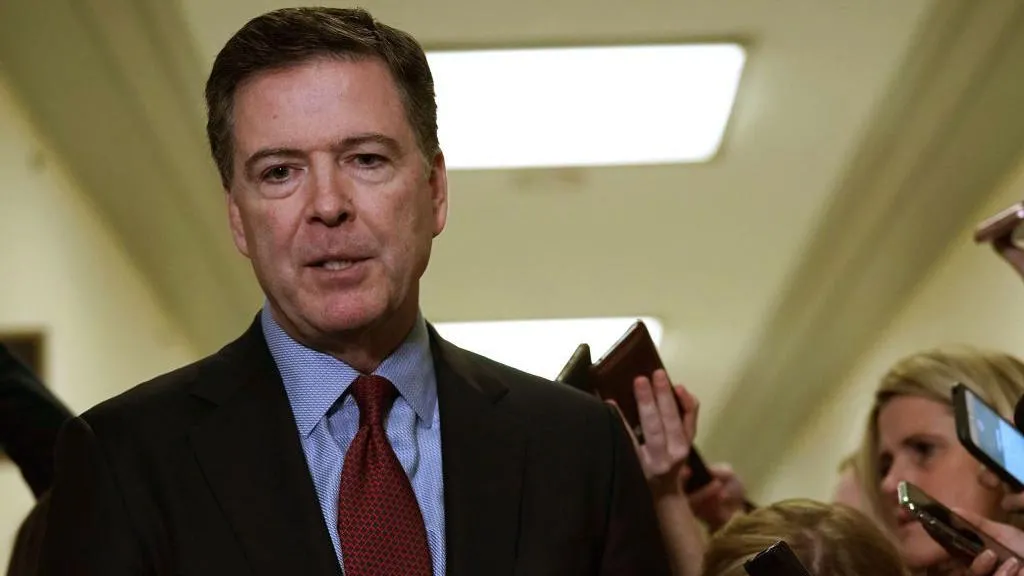
Former FBI Director James Comey has been indicted on two criminal charges, making him the first ex-head of the bureau to face such allegations in U.S. history. The charges include one count of making false statements and another of obstruction of justice. His arraignment is scheduled for October 9 in Alexandria, Virginia.
According to the charging documents, Mr Comey directed an unnamed individual to act as an anonymous source in media reports concerning an FBI inquiry. Prosecutors allege he did so “willfully and knowingly,” while later denying under oath that he had ever authorized such actions.
The case is being led by Lindsey Halligan, the new U.S. Attorney for the Eastern District of Virginia. Halligan, previously known as one of Donald Trump’s personal attorneys, assumed her post on Monday after the firing of former prosecutor Erik Seibert. Her sudden elevation has already stirred political debate given her past ties to Trump.
At the center of the indictment is Comey’s testimony in 2020, when he reaffirmed statements he had made in 2017, insisting that he had not disclosed nor approved the disclosure of FBI information concerning Trump or Hillary Clinton. Prosecutors now argue those statements were false.
The obstruction charge is tied to Comey’s alleged effort to mislead the Senate panel, thereby interfering with its oversight role. The indictment states that Comey “did corruptly endeavour to influence, obstruct and impede” the committee’s inquiry into FBI practices at the time.
The Justice Department originally asked the grand jury to weigh three potential charges, but jurors agreed there was only sufficient evidence to support two. The panel declined to indict on an additional count of making false statements.
A grand jury, made up of ordinary citizens, does not determine guilt but rather establishes whether probable cause exists for charges to proceed. In this case, the grand jury’s decision moves the matter to open court.
The indictment recalls a long and fraught chapter of American politics. In 2017, Comey authored memos documenting conversations with Trump, including claims that the then-president urged him to drop an investigation into Michael Flynn’s ties to Russia. Those memos were later leaked to the press, fueling speculation and controversy.
Critics of Comey argue that his conduct demonstrated an effort to manipulate public opinion while concealing the truth from Congress. Supporters counter that the indictment is a politically motivated prosecution driven by Trump allies determined to settle old scores.
Bondi, a Justice Department spokesperson, said in a statement that the indictment “reflects this Department of Justice’s commitment to holding those who abuse positions of power accountable for misleading the American people.”
If convicted, Comey could face up to five years in federal prison. Legal experts note that penalties for false statements to Congress are serious, particularly when tied to obstruction charges, though sentencing would ultimately depend on judicial discretion.
Comey’s attorney, Patrick Fitzgerald, issued a brief statement on Tuesday evening denying the allegations. “We look forward to vindicating him in the courtroom,” he said.
In a separate video message, Comey addressed the charges directly. “My family and I have known for years that there are costs to standing up to Donald Trump,” he said. “We will not live on our knees, and you shouldn’t either. And, I am innocent. So, let’s have a trial.”
The arraignment will be closely watched nationwide, as it represents not only a legal reckoning for a former FBI chief but also the deepening of partisan battles that have defined American politics since 2016.


