
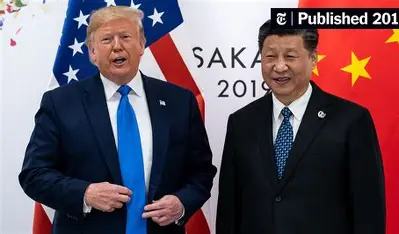
Washington, D.C. — China is quietly positioning itself to become a key investor in America’s next phase of economic growth, offering a series of proposals designed to appeal directly to former President Donald Trump’s focus on jobs, infrastructure, and manufacturing. According to diplomatic sources and trade analysts, Beijing is preparing a charm offensive aimed at rekindling economic cooperation with Washington, particularly if Trump returns to the White House.
Reports indicate that several Chinese business delegations, backed by state-linked firms, have begun discreet contacts with American intermediaries and corporate figures close to Trump’s circle. The proposals include plans for new factories in the Midwest, electric vehicle supply chain projects, and infrastructure investments in regions hit by industrial decline. The goal, according to analysts, is to align Chinese offers with Trump’s long-standing promise to revive American industry and bring back jobs.
“Chinese officials are carefully studying Trump’s economic playbook,” said Dr. Melissa Hargrove, a senior fellow at the Brookings Institution. “They understand that his political brand is built on creating jobs in swing states. If they can present investments that appear to benefit American workers, they believe he will be open to negotiation.”
The timing of these overtures is significant. U.S.-China relations have been strained by disputes over trade, technology, and security, but behind closed doors, both sides appear to be exploring ways to restore limited cooperation in sectors where mutual benefits exist. Sources familiar with the talks say discussions have centered on manufacturing partnerships, renewable energy, and advanced logistics.
For Beijing, the approach represents both an economic and strategic calculation. After years of trade tension and tariff battles, Chinese officials see potential value in engaging Trump through the language of investment rather than confrontation. During his first term, Trump often praised countries that built factories in the United States and created local jobs, using such announcements to demonstrate economic success.
“Trump sees investment as proof that his policies are working,” said Harold Lin, a Hong Kong-based trade consultant. “If China offers projects that look like a win for the U.S. economy, Trump will at least consider them. Beijing is betting on that reaction.”
Trump’s campaign advisers have remained cautious but did not dismiss the idea of future cooperation. A senior aide told Innovation Times that the former president is open to “any legitimate investment that creates American jobs and benefits the U.S. economy,” but stressed that “all deals must be fair and transparent.” The aide declined to confirm whether Trump or his team had direct contact with Chinese representatives.
China’s embassy in Washington issued a brief statement confirming that it supports “mutually beneficial economic cooperation between China and the United States.” The statement said Chinese investment can “promote growth, innovation, and opportunity for both nations.”
However, skepticism remains strong in Washington. Many lawmakers and security analysts warn that China’s renewed interest in U.S. investments could be motivated by political influence rather than economics. “Beijing never makes major investments without a long-term strategic goal,” said Senator Tom Cotton of Arkansas. “Any financial offer must be viewed carefully to ensure it does not compromise U.S. security.”
Over the past year, the U.S. Committee on Foreign Investment has blocked several proposed Chinese acquisitions, citing national security concerns. Analysts predict that any large-scale Chinese investment in the U.S. would face intense scrutiny, especially if it involves advanced technology, minerals, or energy infrastructure.
Despite the tensions, Trump’s campaign rhetoric suggests he may be open to deals that benefit American workers. At a recent rally in Nevada, Trump said that “America will do business with anyone who respects our workers, our economy, and our laws.” Political observers believe that statement was intended to signal flexibility while maintaining a tough image.
For Beijing, the outreach also serves a diplomatic purpose. China’s domestic economy has slowed, prompting its leaders to seek new trade and investment opportunities abroad. Renewed engagement with the U.S. could help restore market confidence and signal stability at a time when global investors are increasingly cautious.
“China wants to show the world that it remains open for business,” said Laura Chen, an analyst at the Center for Strategic and International Studies. “By targeting Trump, Beijing is trying to frame cooperation as a practical, jobs-driven partnership rather than a political compromise.”
While the full details of China’s investment proposals remain undisclosed, sources close to the talks suggest that Beijing is willing to provide significant funding for joint projects that can be branded as “Made in America.” Such ventures would help China counter accusations of economic aggression while appealing to Trump’s focus on domestic manufacturing.
The challenge, experts say, is political timing. Both nations are heading into a highly charged election year, and any appearance of cooperation could trigger criticism from Trump’s rivals and U.S. lawmakers who favor a hard line on China. Still, Beijing appears willing to wait, laying the groundwork for potential engagement after the 2024 election.
For now, Trump has not commented publicly on the reports. But insiders believe he would welcome the idea of new investments if they can be presented as wins for the American worker. “He wants deals that look good politically and economically,” said Dr. Hargrove. “If China offers something tangible, he might take it seriously.”
The coming months will reveal whether Beijing’s strategy can succeed. For China, the stakes are high — rebuilding its image as a global investor while avoiding further isolation. For Trump, the prospect of foreign-backed job creation could fit neatly into his campaign narrative of restoring America’s economic strength.
As one senior diplomat in Beijing put it, “Both sides know the risks, but both sides also know that opportunity often comes disguised as diplomacy.”


